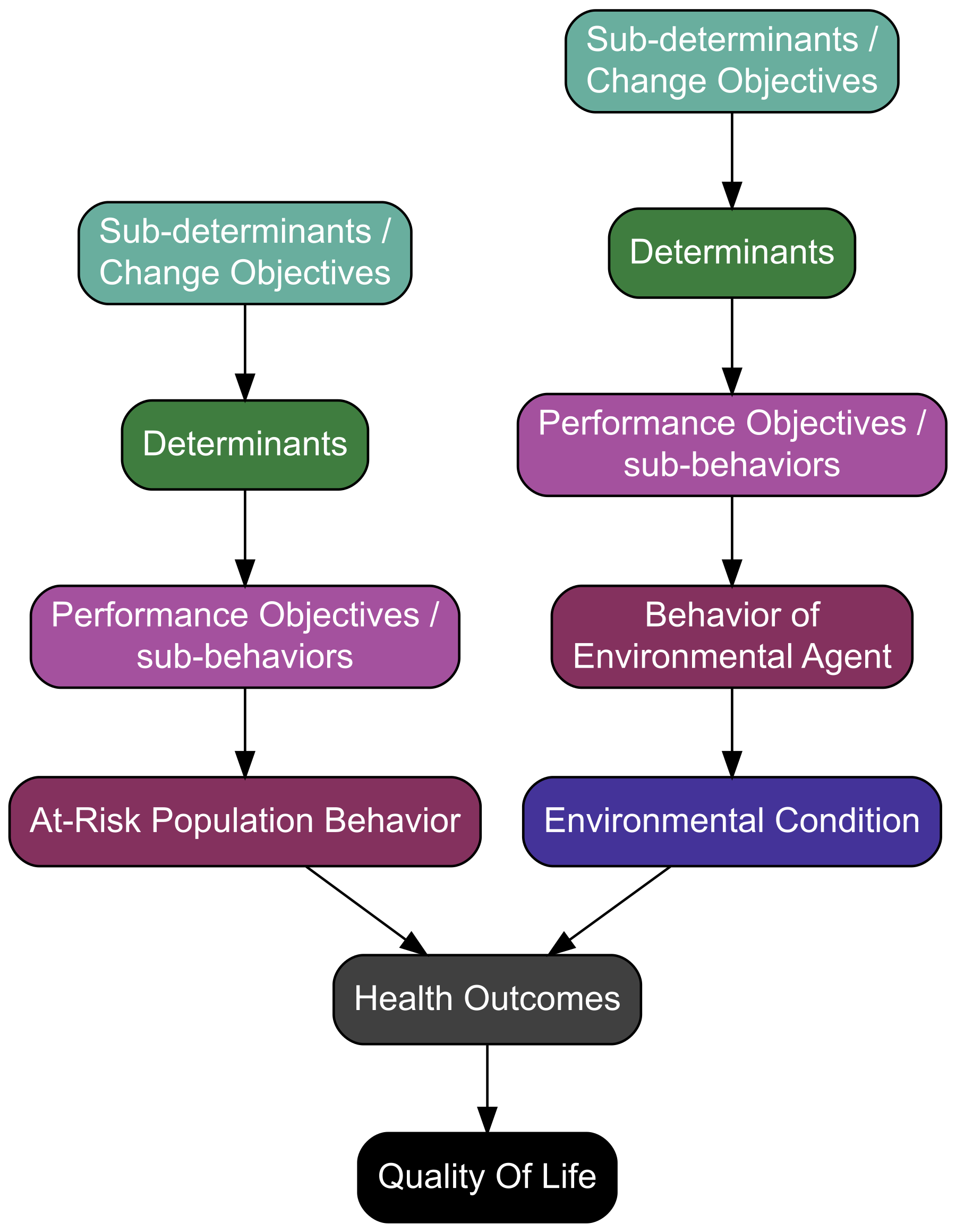
Step 2#
Intervention Outcomes and Objectives#
In Step 1, the focus was on the problem and the behaviors related to this problem. However, when you want people to do something differently, you have to be able to recommend a course of action to replace the undesirable behavior or to increase desirable behaviors: you want to change behavior. IM experts call this “the Flip”. Step 2 starts with “The Flip”.
In the 4th edition of the Intervention Mapping textbook, Step 2 is discussed in Chapter 6, where the following learning objectives and tasks are discussed:
State desired behavioral and environmental outcomes
Specify performance objectives for behavioral and environmental outcomes
Select determinants for behavioral and environmental outcomes
Construct matrices of change objectives
In this work book, we still do the same work. However, the following exercises deviate from the structure in the textbook, as it is easier to split up each task into subtasks.
The Flip#
List target group#
First, you decide on the target group (the population whose behavior your program should change). This can be the at-risk group, but it is also possible that your intervention will have to target another group. For instance, when your at-risk group is “new-born baby’s” your target group will likely be the parents, or GP’s. The target population concerns the individual level agents, specifically, individuals whose behavior change is needed to improve the health outcomes of the at-risk group.
Define the target behavior#
Second, you define the target behavior. This is the desirable behavior of the target group: what needs to change in the behavior of the target population?
List environmental conditions#
Third, list the environmental conditions you want to realise. Similar to the target behavior, this should be the desirable state.
Note that in Step 1 environmental program goals are not always specified. In that case, you also do not specify environmental conditions here yet (but you may still end up specifying environmental conditions below).
Environmental conditions typically resolve or mitigate barriers your target population may encounter. Make sure you do not fall into the trap of including “potential interventions” here.
Tip
Examples In many situations, but not all, examples of “wrong” environmental conditions are:
The school does not provide enough education
Or, formulated flipped into the desirable state: the school provides adequate education
Parents, peers, or colleagues do not discuss subject X enough
These are problematic because you are sneakily thinking about interventions you might want to implement. However, if you start thinking about interventions or solutions already in this phase, you will narrow your perspective and become biased, prohibiting you from attaining a full understanding of the situation.
In addition, realize that environmental conditions are typically things that could come out of an interview with a target population member. Because of this, they are often not the absence of something, because people rarely experience the absence of something as a barrier.
Identify sub-behaviors/performance objectives#
Target behaviors are often very broadly defined (see the examples below). It is therefore important to identify the sub-behaviors that make up the target behaviors. These ultimately being objectives you want to achieve with your intervention. In Intervention Mapping, these sub-behaviors are called Performance Objectives (Fernandez et al., 2026; Peters, 2014).
Note
Guiding questions To identify the performance objectives for your target behavior, ask yourself the following question: “What do the people have to do to perform this target behavior?”
Formulate performance objectives in a way that includes the target group and that makes them measurable and that describes action, for example in the form of a statement like “[target population] [sub-behavior]”, such as “Women recovering from breast cancer register at their local gym”.
A major mistake is to formulate performance objectives as determinants, for example, by expressing skills or self-efficacy. For example, “X should be able to do Y”. That statement does not describe the performance of an action; it describes a prerequisite for performance of an action. A performance objective should be: “X does Y”.
A useful guideline is that if all performance objectives, as you formulated them, are true, the target behavior should by definition be performed.
Tip
Examples For example, when the target behavior is “washing hands”, valid sub-behaviors or performance objectives are:
Use soap
Wash hands at least 20 seconds
Clean thoroughly, also the wrists and under the nails
Use paper towel to dry hands
Use paper towel to close the water tap
For example, when you want to promote condom use, a health promoting behavior, you want people to plan condom use:
Plan to purchase condoms
Go to the store and buy condoms
Use condoms
“In real life”, if you did not select a target group and target behavior in The Flip, you do not select performance objectives here yet. Also note that even if in a situation in which you do not focus on the behavior of the target population itself, you will still select performance objectives for your environmental agent(s). This aligns with the foundational perspective of Intervention Mapping adopting an ecological approach.
Important
Products
List the performance objectives that comprise the target behavior.
Identify environmental conditions and environmental agents#
In this task, you define the environmental conditions that must be in place to support your intervention goals, and identify the environmental agents responsible for influencing or maintaining those conditions.
Start by listing the desirable environmental conditions. These are the ideal states or circumstances in the environment (physical, social, organizational, or political) that need to be realized to support the health or behavior outcomes that are targeted. Similar to the target behavior for individuals, these conditions represent the desired state of the environment.
At every environmental level, such as interpersonal, organizational, community, or policy, environmental agents exist. These agents are individuals, groups, or organizations that have the power or responsibility to influence or control specific environmental conditions.
In this section, you merge two lists:
All environmental conditions that you listed in The Flip.
All environmental conditions for the performance objectives.
Note
Guiding questions For each performance objective, specific environmental conditions may be relevant. To identify these think about what could be barriers hindering each performance objective, and what could facilitate them?
Tip
Examples
Target behavior: handwashing at work
Environmental condition = Soap is available in every bathroom at work
Environmental agent = the boss, at the organisational level
Environmental agents’ target behavior = the boss provides soap
Performance objective 1: the boss buys soap
Performance objective 2: the boss tasks an employee to regularly refill soap containers
Target behavior: condom use in gay sauna
Environmental condition: sauna visitor is welcomed in a non-judgmental fashion towards using condoms in the sauna
Performance objective 1: sauna employees receive customers in a non-judgmental fashion and have an empathic attitude, interpersonal level
Performance objective 2: sauna owner buys condoms, organisational level
Important
Products
List all potentially relevant environmental conditions.
For each environmental condition, list the corresponding environmental agent(s).
For each agent, list their environmental level, for example the interpersonal level, the organizational level, and the community or societal level.
Identify environmental agent (sub-)behaviors#
Environmental agents control their corresponding environmental conditions through their behavior.
To achieve the environmental conditions you aim for, you need to identify what those environmental agents need to do. Similar as for target groups, this means identifying the constituent performance objectives, or sub-behaviors.
Target behaviors#
In many cases, environmental agents will be involved in work you yourself are unfamiliar with, so a good specification of the target behaviors is sometimes not straightforward and requires involving them (e.g., in your planning group). If representatives of these environmental agents are not yet part of your planning group, broad definitions are acceptable at the target behavior level.
Sub-behaviors / performance objectives#
Because target behaviors for environmental agents are broadly defined, intervening on them requires specification. You specify them by formulating sub-behaviors or performance objectives. So, repeat what you did for the target group, but do it now for the environmental agents’ target behaviors.
Note
Guiding questions To find out the performance objectives for the environmental conditions, ask yourself the following question: “What does the environmental agent need to do to accomplish the changes in environmental condition?”
Tip
Examples
Environmental condition = hand hygiene resources are available for employees
Environmental agent = employer
Target behavior of environmental agent = “make hand hygiene resources available”
This target behavior is accomplished through the following performance objectives:
employer adjusts budgets for purchasing soap, towels, etc
employer tasks somebody with ensuring full soap dispensers
Environmental condition = people keep 1.5 meter distance in a small street
Environmental agent = municipality
Target behavior of environmental agent = “clearly indicate with signs that people should keep distance”
Performance objective = municipality orders the placing of signs, organisational level
Important
Products
List the target behavior for each environmental agent.
List the performance objectives for each target behavior.
Identify determinants and sub-determinants#
If you get to this point, you mapped out the more concrete parts of the intervention. You should next get a clear idea of what the world should look like: what do you think the environment of the important groups in your situation should look like, and how should everybody in those groups behave, for example the at-risk group, the target group, and one or more environmental agents?
To achieve these even more tangible goals, people will need to change their behavior. This concerns behavior of the at-risk group and the target group as well as the behavior of the environmental agents that is instrumental to achieving the environmental conditions.
Roughly speaking, people’s behavior is a consequence of their environments and their psychology. You have identified the relevant environmental influences and processed them above as environmental conditions, which yielded environmental agents and their behaviors. That means that at this point, only psychology remains.
There are many theories that explain why people behave like they do. Each theory is designed for a specific purpose: some deal with habitual behavior, some with health behavior, some with reasoned behavior, and some with impulsive behavior. These theories postulate constructs to describe aspects of human psychology that, according to the relevant theory, contribute to determining behavior. In the context of behavior change, constructs that are theoretically assumed to predict behavior are called determinants.
Determinants are generally defined at a general level. For instance, attitude, habits, perceived norms, self-efficacy, willingness, self-identity, and risk perception are all determinants. Such general definitions are useful when studying human behavior over a variety of populations and behaviors, but the generic level of definition provides no guidance for intervention development. For an overview of determinants, see Psychological Construct Repository at https://psycore.one.
In an intervention, you do not target “attitude” as such, for example, you communicate about specific facts or list specific advantages or disadvantages. Neither do you target “self-efficacy” as such, you boost people’s confidence in dealing with specific challenges when engaging in a behaviour. Therefore, when developing a behavior change intervention, the most important thing is identifying the more specifically defined sub-determinants.^[Note that it is also crucial to know the corresponding overarching determinants - you will need that information in step 3.] Sub-determinants are the specific beliefs that underlie broader psychological determinants such as attitude, perceived norms, or self-efficacy. For example, if the determinant is attitude, a related sub-determinant might be the belief that “recycling takes too much time”. You identify the relevant sub-determinants and determinants for each performance objective in two steps: listing and selecting.
Long-list determinants and sub-determinants#
First, you establish a long list by simply including everything that might be important. Normally, you do this for every performance objective - for the target behavior of your target population, but also for the target behavior of each environmental agent.
Note
Guiding questions
Brainstorm and use literature and behavioral theories, see chapter 2 of the book, to compile a long list of determinants for the individuals’ target behavior and for the environmental agent(s).
Tip
Examples Target behavior individual = hand washing
Determinants of the individuals’ target behavior:
expectations regarding effectiveness of hand washing
degree to which hand washing is automated
Environmental agent = employer
Determinants regarding hand washing:
belief that handwashing will reduce work production
belief that illness will reduce work production
perceived norm regarding good employership
Environmental agent = gay sauna owner
Target behavior = promoting safe sex in the sauna
Determinants regarding safe sex:
expectation that more customers will come when free lube is provided
potential false belief: with free lube, people will slip and die
Important
Products
Create a long list of potential (sub-)determinants in the spreadsheet linked to from the Google doc, complete columns A-E.
Select, defer, or forgo determinants and sub-determinants#
Second, you go through the list and you select those sub-determinants and determinants you wish to keep for your intervention. There are three potential actions at this point:
Select a (sub-)determinant: you will retain this (sub-)determinant for Step 3, to target it with your intervention.
Defer a (sub-)determinant: you lack the resources to also target this (sub-)determinant in this intervention. You think that this (sub-)determinant is important and changeable, but you keep it for potential future iterations of your intervention.
Forgo a (sub-)determinant: you decide that the (sub-)determinant is probably not so important for the target behavior, or that it is important, but not changeable with the means you have available or can conceivably secure in the future.
Select from your list the most relevant determinants for your intervention that are important and changeable. Consult the literature and your common sense to make these decisions.
Note
Guiding questions
Program planners refine determinants of behavior by assessing their relevance (strength of association with the behavior) and changeability (likelihood of being influenced by interventions), using research evidence, theory, or related-behavior data when direct evidence is lacking. Some determinants, such as subjective norms, are personal and more easily targeted, while actual norms are environmental and harder to modify, often requiring environmental-level strategies. In cases where environmental conditions cannot be changed, interventions may focus on helping the target population adapt. This prioritization ensures that interventions focus on the most important and changeable factors to improve program effectiveness.
Decide for each determinant whether to select, defer, or forgo it, based on information about the determinants’ associations to behavior or proxies of behavior in the case of the population, and information about the changeability of the determinants, for example based on psychological theory.
There are multiple approaches to select determinants, one of which is the Confidence Interval-Based Estimation of Relevance (CIBER) approach, which visualizes confidence intervals for the means and correlation coefficients (Crutzen et al., 2017). As intervention developers, we need to decide which determinants to include in an intervention. The CIBER approach aids this process by presenting two key pieces of information: the room for improvement (reflected in mean scores) and the association between determinants and intention or behavior (reflected in correlation coefficients). This visualization aids in evaluating the relevance of each determinant by identifying those that are both strongly associated with the behavior and changeable. For example, a determinant like self-efficacy might have a strong correlation with behavior, but if most people already score high on self-efficacy, there is little room to improve it, making it a less effective intervention target. By considering both association and room for improvement, CIBER guides intervention developers to prioritize determinants that are most likely to impact behavior change and can realistically be influenced.
Tip
Examples Here are links with examples of determinant selection based on importance and changeability:
Hearing protective behaviors (De Zeeuw et al., 2025): https://doi.org/10.31234/osf.io/p3myj_v1
Using a high dose of MDMA (Crutzen et al., 2017): https://www.ncbi.nlm.nih.gov/pmc/articles/PMC5508122/
Dementia risk reduction (Bruinsma et al., 2024): https://doi.org/10.3233/JAD-231369
Important
Products
Process each sub-determinant listed in the spreadsheet doc and select, defer, or forgo each (sub-)determinant, completing columns F and G.
Select environmental conditions, and so agents, and sub-behaviors and sub-determinants#
Out of the long list, decide which you select. If you do not select something, you can either defer (retain for potential later intervention) or forgo (eliminate, e.g. because it’s irrelevant).
Tip
Examples Selection can be based on how important something is for the behavior, relevance, usually correlational evidence, and how easy it is to change, changeability.
Important
Products
List your decisions regarding environmental conditions and agents.
Produce Matrices of Change Objectives#
Matrices of change objectives are generally made for each level of intervention planning:
Individual
Interpersonal
Organizational
Community
Societal
If there are multiple agents at a specific level, then it is recommended to have separate matrices for each agent.
Change objectives are the specific goals of your intervention. Change objectives literally state what should change in that person (i.e., that the individual level or among environmental agents. A change objective is a sub-determinant that you selected from the long list, but reformulated. Change objectives are constructed by crossing performance objectives with determinants. You formulate change objectives according to similar principles as you applied for performance objectives. Change objectives are statements that, when true, mean that the corresponding sub-determinant has been achieved. The idea is that while sub-determinants express a psychological state or process, change objectives are formulated to be measurable (‘SMART’).
SMART refers to:
Specific: define your change objectives as specific as possible.
Measurable: can you measure the change objectives?
Achievable: are the change objectives you set achievable and attainable?
Realistic: can you realistically achieve the objectives with the resources you have?
Time: within what period will you achieve your change goals?
Note
Guiding questions For change objectives at the individual level ask: “What do people need to learn with regard to the determinant to do the performance objective?”
For example, for a change objective regarding self-efficacy, you might ask: “What do people need to learn with regard to self-efficacy to carry a condom?”
For environmental level change objectives you might ask: “What do agents need to learn with regard to the determinant in order to do the performance objective?”
For a change objective regarding social norms in the community you might thus ask: “What do people in the community need to learn in order for the person to keep a social distance in a busy street?”
Formulate change objectives in a way that makes them measurable by using active verbs such as “shows”, “indicates”, and “demonstrates”.
Note that determinants that you deferred or forwent are not included in your Matrix of Change Objectives.
Tip
Examples IM change objectives have to be specified explaining who and what will change as a result of the intervention.
Who or what will change can be at:
the individual level of change, for example “adolescents will express confidence regarding negotiating condom use with a sexual partner”
the organizational level change, for example “sauna owners will acknowledge the advantages of condom distribution in the sauna”
the community level change, for example “community leaders will approve of extracurricular physical workouts in school buildings”
The Matrix of Change Objectives is structured as follows:
Each row corresponds to a performance objective.
Each column corresponds to a determinant.
Each cell contains all change objectives for that performance objective and determinant.
Note that some cells will contain multiple change objectives, and some cells will be empty, because not all determinants are important for all performance objectives.
Here are links with examples of the Matrix of Change Objectives:
Stigma reduction (Stutterheim et al., 2025): https://cris.maastrichtuniversity.nl/ws/portalfiles/portal/188616494/Stutterheim-2023-Intervention-Mapping-as-a-Guide.pdf
Vaccination uptake (Evers et al., 2023): https://doi.org/10.1186/s12889-023-17311-1
Adolescent smoking cessation (Dalum et al., 2012): https://doi.org/10.1093/her/cyr044
Important
Products
Produce a Matrix of Change Objectives for each target behavior, for the target group and for each environmental agent.
Start on the logic model of change#
The logic model of change is a model showing how you expect your intervention to work. These logic models can be easily produced using Acyclic Behavior Change Diagrams (ABCDs) (Metz et al., 2022).
ABCDs are a visualization tool specifically designed to help clarify how an intervention is expected to bring about behavior change. An ABCD presents a chain of seven causal links that illustrate the logical connections between different elements of the intervention:
Which behavior change principles (also called behavior change methods) are used;
Whether these methods are applied correctly, according to their parameters for effectiveness (also known as parameters for use);
How the methods are applied in the context of the specific intervention;
Which sub-determinants the application targets;
Which broader determinants these sub-determinants fall under;
Which sub-behaviors/performance objectives must be performed;
What the overall target behavior is.
To produce the ABCDs, you first fill in the ABCD matrix. The ABCD matrix is a table into which you copy-paste the information in your Matrix of Change Objectives. This ABCD matrix is then used to produce the ABCD itself.
Open the Matrix of Change Objectives that you just produced, and open the empty ABCD matrix provided in the Google document. Then, copy the following cells from the Matrix of Change Objectives spreadsheet to the ABCD matrix spreadsheet:
Cell A1 lists the target behavior: copy it to cell G2, and then duplicate it to the cells in column G for every row you end up filling in the ABCD matrix.
The row headers, column A, contain the performance objectives, the sub-behaviors. Copy these to column F of the ABCD matrix.
The column headers, row 1, contain the determinants. You will eventually copy these to column E of the ABCD matrix.
In the cells, the Matrix of Change Objectives contains the Change Objectives themselves. These are sub-determinants that have been rephrased according to the specific guidelines for Change Objective phrasing. Each of these sub-determinants or Change Objectives has its own line in the ABCD matrix.
After you copied all sub-determinants or Change Objectives into column D of the ABCD matrix, verify that every row also has the corresponding determinant in column E, the corresponding sub-behavior or performance objective in column F, and the corresponding target behavior in column G.
You will fill in columns A, B, and C in Step 3.