Step 1#
Needs and Assets Assessment#
Intervention Mapping guides planners through the process of intervention design by means of a series of steps and tasks. It also provides tools and aids to structure and monitor the work during the process: matrices, tables, lists and working documents.
Intervention Mapping Step 1 involves an analysis of the problem, the community needs and assets. This analysis addresses what exactly the problem is, how people’s quality of life is influenced by the problem, causing behavioral and environmental conditions, as well as the determinants influencing the behaviors of the at-risk population and decision makers responsible for the environmental conditions, next to an assessment of the capacities within a community that are potentially useful in improving community health.
In the 5th edition of the Intervention Mapping textbook (Chapter 5), Step 1 includes the following tasks:
Establish a planning group
Conduct a needs and assets assessment
Describe the context for the intervention including the community, population, and setting
State intervention goals
In this work book, we will do the same work. However, in the following exercises, we deviate from the structure in the book by splitting up each task into subtasks, which makes it all easier.
In this workbook, we use boxes with different colours to clearly signal types of content:
Note
Guiding questions Questions to guide the application of Core Processes, mostly brainstorming.
Tip
Examples One or more examples to help you along.
Important
Products One or more products, usually to complete in the exercise document, associated spreadsheets, or Google Sheet or presentation.
Task: Planning group#
To ensure that you comprehensively define your problem, IM starts with a planning group, the first task of which is to gather data from multiple sources about the problem and its background. This is to better understand all the facets of the problem, and to estimate the feasibility of possible interventions. Usually this will be a combination of a work group and various advisory groups, consisting of members of the community, including those who experience the problem, often this is your target group (or for instance when you want to change behavior in children, your target group will be the parents of the at-risk group) and individuals with the relevant expertise. For example, if the health issue is malnutrition among children under five in Afghanistan, the planning group may include:
Public Health Experts and Healthcare Providers: Specialists in nutrition, maternal-child health, and epidemiology who can provide technical guidance.
Behavioral Scientists: Experts in behavior change and social determinants of health to inform intervention strategies.
Community Representatives: Parents, caregivers, religious and local leaders who bring firsthand knowledge of challenges and cultural dynamics.
Policymakers: Government officials from relevant ministries (e.g., health, education) to support policy alignment and resource allocation.
Representatives of NGOs and Humanitarian Organizations: Groups engaged in child nutrition, food security, and health programs that offer operational support and community outreach.
Media and Communication Specialists: Professionals who develop culturally appropriate campaigns to promote awareness and behavior change.
Representatives of Funding Organizations: Entities providing financial and technical support to sustain and scale interventions.
The planning group should be large enough to include diverse perspectives but small enough to allow for productive discussions. Not all members need to be involved in every single step or meeting of the IM steps. In practice, a core team may handle the coordination and documentation and specialists or community members may be invited to contribute input at specific steps relevant to their expertise or experience. Consultations with relevant stakeholders can be conducted in various formats, including online or in-person, group sessions, or individual meetings.
Core Processes can be used to identify key stakeholders for inclusion in the planning group. This may involve brainstorming within the expert team and conducting a stakeholder analysis to determine which individuals and groups should be involved. Ideally these should all be involved as early on in the process as possible. However, new insights might lead to the need of adding additional people to the planning group over time. Below is an example of how Core Processes brainstorming can be used to help form the planning group at the beginning of a project.
Core Processes#
Who would you ask for your planning group? To help answer this question, brainstorm about questions such as:
Note
Guiding questions
Who represents your target population? For example, members of the at-risk group are important participants in a planning group.
Who are possible environmental agents, for example decision makers?
Who are the potential program implementers, for example the professionals who are going to implement your program?
Examples#
Tip
Examples We want to increase physical activity in young children, and decrease overweight, but the at-risk group is a bit too young for the planning group, so asking parents, a possible target group, is an idea.
Prevention workers and members of the local health council, a decision maker
The head of schools, the implementers
Experts in physical exercise and obesity in children
You also want people who are critical of your ideas, and who are not convinced about the intervention. They may provide you with good feedback that will eventually improve the intervention.
Product#
Important
Products
List the important groups of stakeholders and other populations, groups, and experts that should be included in your planning group.
Task: Conduct a needs assessment to create a logic model of the problem#
Step 1 should lead to answers to a series of questions helping in producing a logic model of the problem:
What is the (health) problem? Why is it a problem at all? Since when has it been a problem, and for whom? What causes the problem? Who needs to be convinced this problem should be solved, who must help solve it? What are the social and psychological aspects of the problem, and which of these aspects could potentially be addressed or resolved?
To answer these questions, IM begins with an analysis of community needs and assets. This analysis addresses people’s quality of life, health concerns and relevant behavioral and environmental conditions, as well as the community capacities that are potentially useful in improving community health.
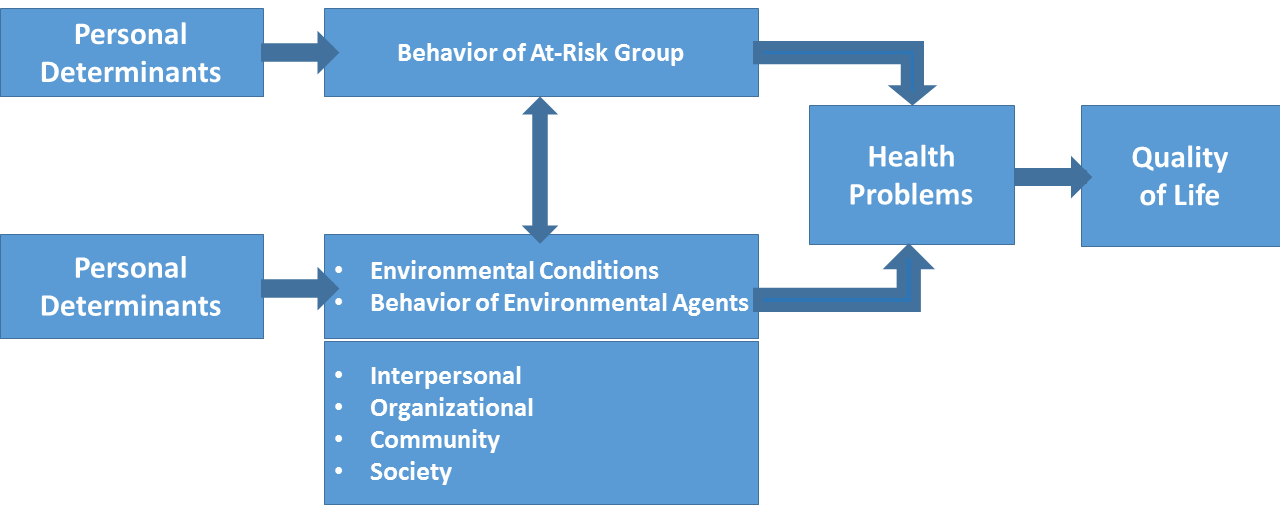
The final output of the needs assessment is the Logic Model of the Problem diagram. This diagram visually represents the health problem, its impact on quality of life, problematic behaviors of at-risk or target group, the environmental agents across various environmental levels, the related problematic environmental conditions, and the determinants of both the target group’s behaviors and those environmental conditions.
Core Processes#
The Core Processes can be used to find answers to these questions, beginning with brainstorming possible answers within the planning group, reviewing existing evidence and theories, and, if necessary, conducting new research.
The fourth Core Process (Ruiter & Crutzen, 2020) concerns identifying relevant theoretical support to better understand and address the identified problem. This Core Process utilizes three complementary approaches: the topic approach, the concept approach, and the general theories approach.
Topic Approach: The planning group revisits the literature to identify theoretical frameworks or models that have been applied in studies related to the problem. These theories may have informed the design of previous research or been used to explain study findings. The planning group then evaluates the relevance and usefulness of these theories in providing additional insight or answers to their formulated questions.
Concept Approach: This approach builds on ideas that emerge during brainstorming sessions. These initial ideas are typically expressed in lay terms but can be better understood by translating them into theoretical concepts. These concepts then serve as search terms to explore relevant literature, which may ultimately lead to the discovery of applicable theories.
General Theory Approach: After applying the topic and concept approaches, it could be useful to employ a general theory approach. This third approach uses a “top-down” strategy, starting with a broad theory of human behavior that may not initially seem directly relevant to the problem. The aim is to explore whether such a theory can provide useful insights or explanations. In essence, this approach involves examining general behavioral theories that might shed light on the question at hand. For instance, a commonly used theory in behavioral science, the Reasoned Action Approach (Fishbein & Ajzen, 2011), proposes that human behavior is primarily guided by behavioral intentions. These intentions are influenced by three key factors: 1) Attitude, which is an individual’s evaluation of the expected positive or negative outcomes of performing the behavior, 2) Perceived Norm, which is an individual’s perception of whether important others approve or disapprove of the behavior, or whether those others engage in the behavior themselves, and 3) Perceived Behavioral Control (or Self-Efficacy), which is an individual’s belief in their ability to perform the behavior, including whether they have the necessary skills and resources. Each of these three determinants is shaped by underlying beliefs regarding the behavior’s consequences, social expectations, and perceived barriers or facilitators.
In this workbook, we primarily focus on the brainstorming phase of the Core Processes to provide practical examples.
Brainstorm about the topic: what do you all already know about the problem? When we say ‘brainstorm’, we mean that you have to try to address all aspects of the problem. Usually, you ask ‘what-where-why-who-for whom’ questions to get to the bottom of the problem. We help you out for your first ‘brainstorm’. In the box below, we listed a series of questions you can ask yourselves to get started. During your brainstorm, you can use some internet searches to get an idea of all aspects of the chosen problem.
Problem Analysis#
Note
Guiding questions
What is the central problem?
Why is it a problem? Is it a serious problem?
In what sense is it related to health? Whose health?
For whom is it a problem, target groups and stakeholders?
Which age-group, or more specific group, do you target?
What behaviors are related to the problem, or cause the problem?
What are the environmental conditions or conditions that are related to the problem?
Who are the environmental agents who can control the environmental conditions, and what do they need to do to change those conditions?
What are the determinants or correlates of the behaviors involved, both for the target population, and for the environmental agents?
Whose cooperation is necessary to help solve the problem?
Describe the context: How does the environment directly or indirectly contribute to the problem?
What are the behaviors of the at-risk group?
What environmental conditions contribute to the problem, at the interpersonal, organizational, communal and societal level?
What would be the best intervention setting?
Who is the at-risk group?
Who is the target group, which can be the same as the at-risk group?
Examples#
Tip
Examples Example: We want to promote social distancing in Amsterdam and we want to target the older population.
At-risk group = 60+ years old citizen
Behavior at risk group = They do not always keep the proper distance when in the streets
Target group = 60+ years old citizen
Environmental conditions = the sidewalks are not wide enough
Environmental agents = the municipality
Example: We want primary school children to exercise more frequently.
At-risk group = primary school children
Behavior at risk group = They play videogames all afternoon
Target group = parents
Environmental conditions = no possibility to play outside
Environmental agents = heads of schools
Task: Describe the context for the intervention including the community, population, and setting#
In Step 1, you do not only map out the problems and their causes, but you also map out your target population’s landscape more generally. Specifically, it is important to identify in which setting the problem occurs (i.e. also aspects that may not play a role for the problem), understand the population (e.g. culture, existing communities, etc), and other assets that you may be able to involve in the intervention later on. This is broadly referred to as the asset assessment. The result is a description of your target population and their surroundings.
Asset assessment in IM helps identify existing resources, social factors, and policies that can support the development and implementation of an intervention (Ravaghi et al., 2023). This process involves evaluating available infrastructure (such as healthcare facilities and community programs), human resources (including health workers and educators), and current initiatives. It also takes into account social and environmental factors, such as family decision-making dynamics and cultural beliefs. Furthermore, asset assessment helps to identify both facilitators and barriers that may influence the success of the intervention.
The following questions can help guide your asset assessment:
What existing social and environmental factors could support the intervention?
Which organizations or community groups are already in place that could assist with the intervention?
What communication channels are currently available and could be utilized for the intervention?
What existing policies and practices could be leveraged to support the intervention?
What features of the natural or built environment could be harnessed to enhance the intervention’s effectiveness?
Task: Stating intervention goals#
Determine your intervention goals. You prioritize the potential goals on the basis of the needs assessment. This includes deciding what behaviors or environmental conditions are most relevant and most likely to change.
State in one sentence the expected change of your intervention and its time frame in clear quantifiable terms. When formulating program goals, use the SMART criteria (Specific, Measurable, Achievable, Relevant, and Time-bound) by specifying: what will change, for whom, by how much, and over what period of time.
Distinguish the following types of goals:
Ultimate program goals: these typically involve the quality of life or health of a specific population, the at-risk population
Environmental program goals: these are the environmental conditions that you want to change in your program
Behavioral program goals: these are the behaviors of the target population you want to change, noting that the target population can be different from the at-risk population
A program always has one or more ultimate goals. The environmental goals and behavioral goals are means to achieve those ultimate goals, but it is possible a program only has environmental goals, or only behavioral goals.
Note that you may want to change behaviors of environmental agents, too. However, in that case, often those behaviors are not the goal as such: instead the environmental condition that is caused or maintained by their behavior is what is most crucial. That environmental condition (e.g. a certain norm) is what influences the problem(s) you want to address, so often you are better off specifying you want to change that environmental condition. In Step 2, you will identify which behaviors each environmental agent needs to change in order to change the environmental condition.
Program Goal#
Note
Guiding questions
Which specific target group do we choose?
What is the current state, for example behavior or outcomes?
How much behavior change can we expect from our target population?
How quickly, or in what timeframe, would it be possible to reach that goal? Is this very likely?
Are effects on relevant health outcomes quantifiable within the chosen relevant and realistic time frame or should we choose a certain behavior or environment?
Note that selecting goals is not a purely theory- and evidence-based decision. It often requires compromises between several interests. For example, there are often political interests. Funders often want to see a certain problem addressed, and may prefer evaluating that problem specifically; or, on the other hand, you may collaborate with governmental organisations that want or do not want certain outcomes to be selected.
Simultaneously, there are methodological considerations: can that problem be measured well? What effect size would you expect, and is that sample size reasonable? Other considerations are theoretical: how quickly do you expect that a potential outcome can change if your intervention is successful? This is often combined with pragmatic considerations, for example how long you will have for the evaluation, and sometimes activistic considerations play a role, too, for example you might collaborate with a volunteer foundation that prioritizes certain outcomes to enhance visibility.
Finally, in the goal, include both the present state, the baseline, as well as the desired result.
Examples#
Note
Examples Reaching the 60+ population is more difficult, and they are physically slower, so although they are the at-risk group, we now choose the younger adults as target group. To do this in the entire city is not feasible, so we focus on one busy street. To set our goals too far in the future would be useless, so we want fast implementation and fast results. The program goal would therefore be to increase social distancing of adults under 30 from 60% to 80% on the sidewalk in the Kalverstraat in Amsterdam within 2 weeks.
We wanted primary school children to exercise more frequently. We chose the following program goals:
to increase physical activity in children between 6 and 10 from an average of by 26 minutes per week to 52 minutes per week and to decrease weight in the overweight children from an average of 72kg to 65kg, following 2 years of our intervention at the schools in Amsterdam-Noord.
to decrease weight in the overweight children between 6 and 10 from an average of 72kg to 65kg, following 2 years of our intervention at the schools in Amsterdam-Noord.
Note that we separated increasing activity and decreasing weight. Here we might picked the parents as the target group (we need them to bring the children to the extracurricular gymnastic classes) or the heads of schools in Amsterdam-Noord (who need to implement our intervention program at their school). By the way: the program goals should be feasible! Our examples might not be that feasible, but at least we focused on a specific age group of children in a specific area (Amsterdam-Noord), instead of ‘all children in the world’.
Products#
Although “in real life”, it is quite possible to not have any behavioral program goals, when working with this workbook, you must select a target group, which can be either the at-risk group or a different population, and a behavioral goal.
Important
Products
List the ultimate program goal(s).
List the environmental program goal(s), if any.
List the behavioral program goal(s).