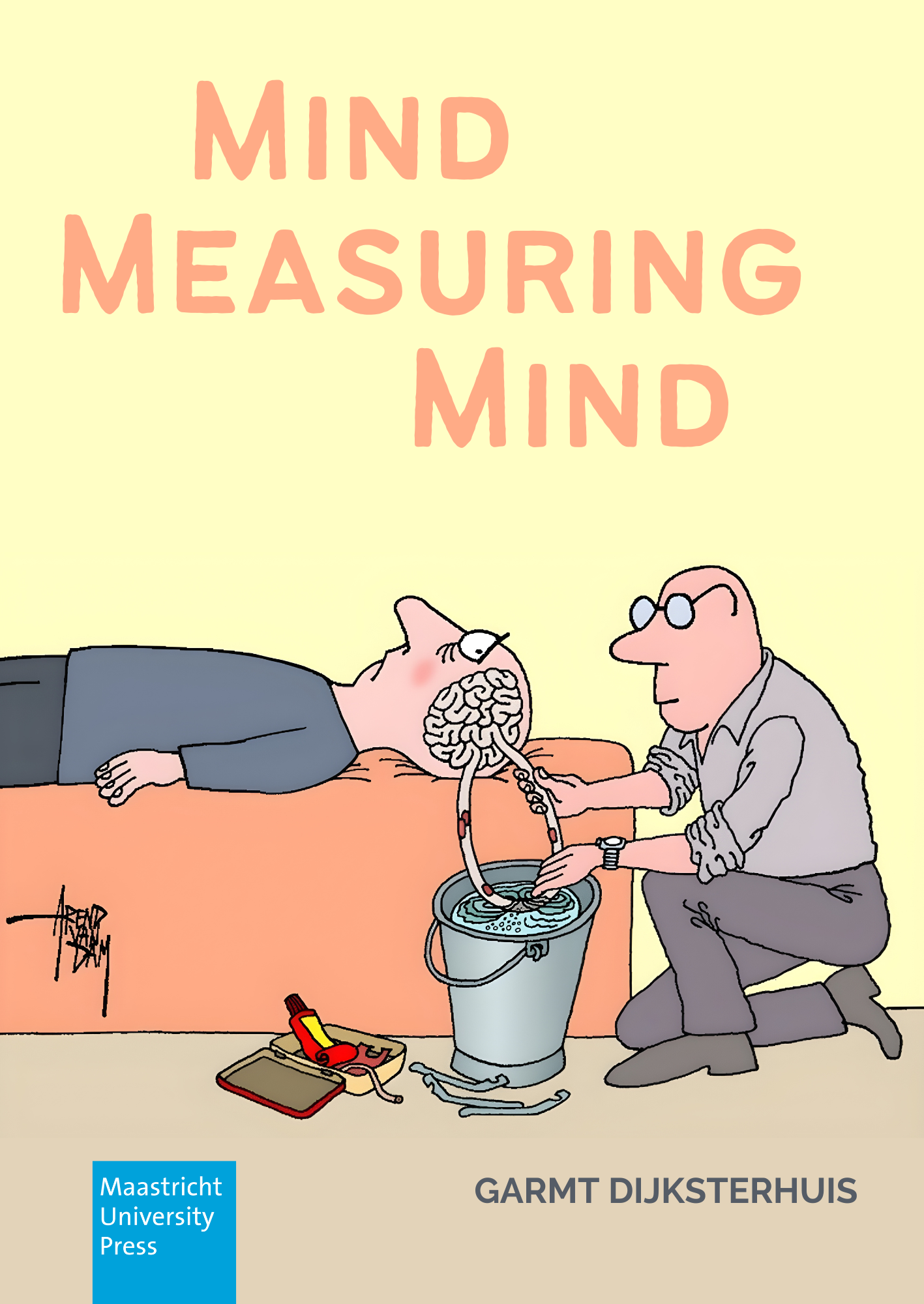
Mind Measuring Mind#
An introduction to psychological science and research, for discussions in a PBL context.
© Cartoon by Arend van Dam, used with permission.
Preface
In the year 2024/2025 the BSc psychology program at UM was completely overhauled. This resulted in a totally new program, and a new approach to teaching and grading. This booklet originated from a UM library grant to make teaching material available for a wider audience than the UM psychology students it was originally aimed at.
An important part of any academic psychology education is teaching students the ‘academic method’, which includes a critical look onto psychology as a science, the empirical cycle, and education in methodology and statistics. Most academic psychology programs also expect their students to take part as subjects in psychological studies. Often these are experiments that are run as part of the research programmes of the psychology faculty, carried out by research faculty and PhD-students. This is no different at UM. As part of this, some PBL-tutorials were created where students were made familiar with the empirical cycle and prompted to have discussions around validity, research methods, ethical standards, scientific communication and threats to responsible and high quality research. The material you find in the book was compiled from these tutorials.
Additional chapters are added on measurement in psychology. Psychological science is a very special science, after all we’re investigating ourselves, hence the title of this book: ”Mind Measuring Mind”. The ramifications of this conundrum are discussed by taking a closer look at what measurement is, particularly what it entails to measure psychological matters. A personal account by the author is added in the last section on the replication crisis in psychological research.
Admittedly, some of the work may reflect the author’s own view on matters, which others may not fully share. However, the presented viewpoints will provide for some discussion about measurement and theory development in applied psychological science. This is precisely what the objective is in the type of PBL here addressed.
Garmt Dijksterhuis
Maastricht University
Faculty Psychology and Neuroscience
Section Innovation in Teaching and Learning